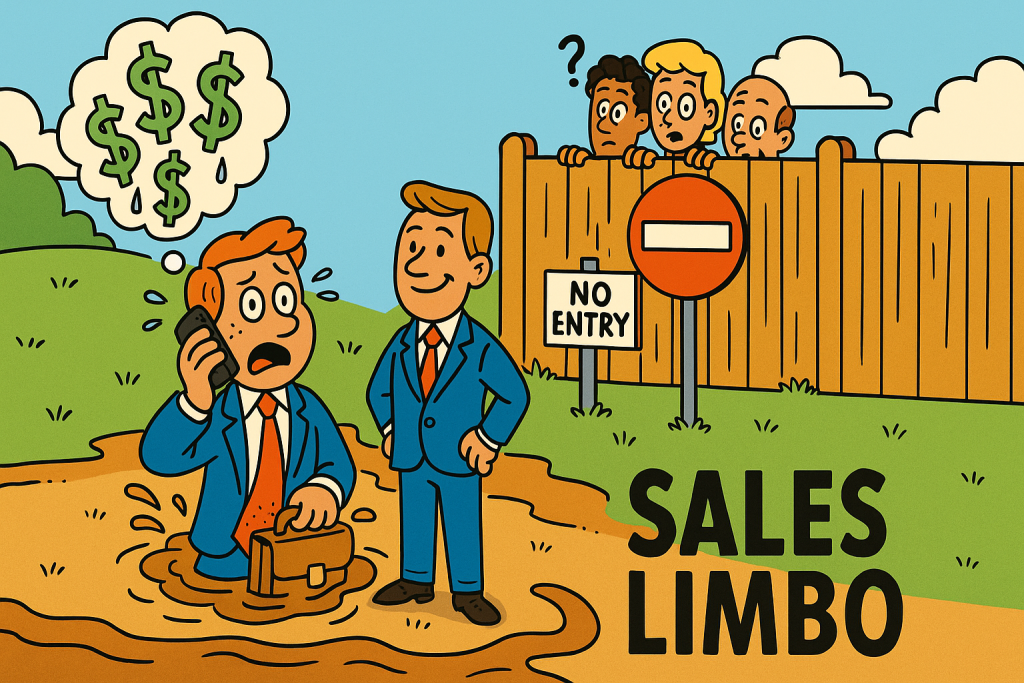
Part 1: The Great Sales Limbo Dance (And Why Most People Suck At It)
When “I’ll Think About It” Really Means “I’m Politely Telling You to Buzz Off”
You know what’s funny about sales? Everyone thinks they’re good at it until someone says those four little words that turn grown salespeople into whimpering puppies: “I’ll think about it.”
Suddenly, Mr. Confident Sales Guy transforms into a desperate teenager asking someone to prom. “So… um… when do you think you’ll be done thinking? Should I call tomorrow? Next week? Should I just camp outside your office?”
Here’s the brutal truth that nobody wants to admit: When someone says “I’ll think about it,” they’re not actually going home to create a pros-and-cons spreadsheet. They’re not scheduling a family meeting to discuss your proposal. They’re doing what humans have done since the dawn of time when faced with an uncomfortable situation – they’re buying time to figure out how to say no without hurting your feelings.
It’s the adult equivalent of “Let’s just be friends.”
The Psychology Behind the Stall (Spoiler Alert: It’s Not What You Think)
Most sales training will tell you that “I’ll think about it” means the prospect needs more information. Wrong. Dead wrong. That’s like saying people eat ice cream because they’re hungry.
The truth is simpler and more uncomfortable: Most people have already made up their mind about whether they want what you’re selling. The “thinking” they need to do isn’t about your product – it’s about how to gracefully exit the conversation.
So why the stall?
Because humans are conflict-avoidant creatures who would rather perform interpretive dance than tell someone “no” to their face. We’ve been conditioned since childhood to be “nice,” which in adult-speak means “lie politely to avoid confrontation.”
Think about it. When was the last time you told a telemarketer, “You know what, Bob from the extended warranty department? Your offer sucks, your timing is terrible, and I’d rather eat glass than give you my credit card number.” Never. You say, “I’m not interested right now” or “Let me think about it.”
The Million-Dollar Mistake Most Salespeople Make
Here’s where most salespeople screw up royally. They hear “I’ll think about it” and immediately go into what I call “Information Vomit Mode.” They start spewing features, benefits, testimonials, and case studies like a broken fire hydrant.
“But wait! Did I mention our 24/7 customer support?” “Have you seen our five-star reviews?” “What if I told you we could throw in free shipping?”
Stop. Just stop.
You’re not dealing with an information problem. You’re dealing with a decision problem. And more information doesn’t solve decision problems – it makes them worse.
Barry Schwartz proved this in his book “The Paradox of Choice.” When faced with too many options or too much information, people don’t make better decisions – they make no decisions at all. They get paralyzed.
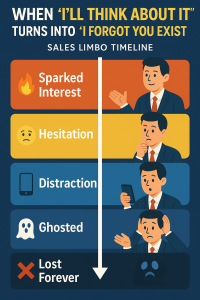
The Real Reason People Stall (And It’s Not Pretty)
Want to know the real reason people say “I’ll think about it”? It’s not because they need more time to process your brilliant presentation. It’s because one of three things is happening:
- They don’t trust youMaybe you came on too strong. Maybe your cologne is too aggressive. Maybe you remind them of their ex-brother-in-law who sold them a lemon car in 1987. Trust is the foundation of every sale, and without it, you’re building a house on quicksand.
- They don’t see the valueThis isn’t about price – it’s about perceived value. A $5,000 watch seems expensive until you realize it’s a Rolex. A $150,000 car seems reasonable when it’s a BMW. Value is subjective, and if they don’t see it, they won’t buy it.
- They’re not the real decision-makerThis is the big one that nobody talks about. Half the time, the person you’re talking to couldn’t buy a candy bar without checking with someone else first. They’re stalling because they need to go ask mommy (or their boss, or their spouse, or their accountant) for permission.
Why Traditional Follow-Up Fails Miserably
Most salespeople handle “I’ll think about it” like they’re defusing a bomb with oven mitts. They schedule a follow-up call for next week, send a few emails with “additional information,” and then wonder why their prospect has suddenly developed a rare form of phone allergies.
Here’s why this approach fails:
It’s predictable. Everyone does it. Your prospect has been through this dance before. They know that agreeing to a follow-up call is just prolonging the inevitable awkwardness.
It adds pressure. Every follow-up call or email reminds them that they’re avoiding making a decision. Instead of moving them closer to “yes,” you’re pushing them toward “no.”
It positions you as needy. When you keep chasing someone who’s clearly not interested, you look desperate. And desperate salespeople don’t inspire confidence.
Part 2: The One-Liner That Changes Everything (And Why It Works Like Magic)
The Line That Separates Amateurs From Pros
Alright, enough foreplay. You want the line? Here it is:
“You know what? I don’t think this is right for you.”
That’s it. Simple. Clean. Devastating.
Now, before you start typing angry emails about how this sounds crazy, let me explain why this line works better than a Swiss watch and why it’s saved more deals than a superhero with commitment issues.
The Reverse Psychology That Actually Works (Unlike Your High School Attempts)
When you tell someone they can’t have something, what happens? They want it more. It’s basic human psychology, and it’s been working since Eve told Adam not to eat the apple.
But this isn’t some cheesy reverse psychology trick you learned from a pickup artist blog. This is strategic disqualification, and it works because it does three things simultaneously:
- It removes pressureThe moment you say “I don’t think this is right for you,” the prospect’s defenses drop faster than a lead balloon. They’re no longer being sold to. The sales pressure evaporates. Suddenly, they can think clearly again.
- It triggers loss aversionHumans hate losing things more than they like gaining things. It’s called loss aversion, and Nobel Prize winner Daniel Kahneman proved it’s a fundamental part of human psychology. When you take your offer off the table, their brain screams, “Wait, what am I losing here?”
- It flips the scriptNow they’re selling you on why they should get it. The hunter becomes the hunted. The seller becomes the buyer. It’s beautiful.
Real-World Examples That’ll Make You Slap Your Forehead
Example 1: The Software Sale Prospect: “This looks interesting. Let me think about it and get back to you.” Amateur response: “Sure! When would be a good time to follow up? I can send you some case studies…” Pro response: “You know what? I don’t think this is right for you. Most companies that say they need to think about it aren’t really ready to commit to changing how they do business. No worries – it’s not for everyone.”
Result? The prospect spent the next 10 minutes explaining why they were absolutely ready to change and asking what they needed to do to move forward.
Example 2: The Consulting Gig Prospect: “Your proposal is comprehensive. I need to discuss it with my team.” Amateur response: “Of course! How long do you think that will take? Should I schedule a call for next week?” Pro response: “Actually, I don’t think we’re a good fit. Companies that need to have long discussions about working with us usually aren’t ready for the kind of rapid changes we implement. I’d hate to take your money and not deliver the results you deserve.”
Result? The prospect called back within two hours asking what it would take to get started immediately.
The Science Behind Why This Works (Prepare to Have Your Mind Blown)
Dr. Robert Cialdini identified six principles of influence in his groundbreaking book “Influence: The Psychology of Persuasion.” This one line triggers three of them simultaneously:
Scarcity: By taking the offer away, you make it scarce. Scarce things are more valuable.
Authority: By confidently stating what is and isn’t right for them, you position yourself as the expert who knows best.
Commitment and Consistency: When they argue back (and they will), they’re making a case for why they want it. Once they verbalize their desire, they become committed to it.
The Delivery That Makes or Breaks the Line
Here’s where most people screw it up. They deliver this line like they’re reading a grocery list or apologizing for stepping on someone’s foot. Wrong, wrong, wrong.
The delivery has to be:
Confident, not apologetic. You’re not sorry. You’re making a professional assessment based on their behavior.
Matter-of-fact, not emotional. This isn’t about hurt feelings. It’s about fit.
Final, not negotiable. You’re not fishing for a response. You’re stating a conclusion.
Think Clint Eastwood, not Woody Allen.
When NOT to Use This Line (Because Context Matters)
This line isn’t a magic bullet that works in every situation. Don’t use it when:
- You’re dealing with a genuine technical evaluation that requires time
- The prospect has already shown strong buying signals
- You’re in a formal RFP process where thinking time is built in
- The prospect has been completely transparent about their decision-making process
Use your brain. If someone says, “This looks perfect, but I need to check with my CFO because any purchase over $10,000 requires his approval,” don’t tell them it’s not right for them. That’s just stupid.
The Follow-Up That Seals the Deal
After you deliver the line, shut up. Let the silence do the work. Don’t fill the awkward pause with nervous chatter. Don’t explain yourself. Don’t backtrack.
If they don’t respond immediately, that’s fine. End the conversation politely and move on. But here’s what usually happens: They start talking. They start explaining. They start selling themselves.
And that’s when you know you’ve got them.
Part 3: The Advanced Playbook (How to Turn “Maybe” Into “Money”)
What Happens After You Drop the Bomb
So you’ve delivered the line. You’ve watched their face go through more expressions than a mime having a seizure. Now what?
Here’s where most people panic and ruin everything. They get scared by the silence and start backpedaling faster than a politician caught in a lie.
“I mean, it COULD work for you…” “Maybe we can make some adjustments…” “Let me talk to my manager about a discount…”
Stop. You just threw a perfect strike, and now you’re apologizing for it? That’s like LeBron James dunking on someone and then helping them up while saying, “Sorry about that.”
The Three Responses You’ll Get (And How to Handle Each One)
Response 1: The Pushback “What do you mean it’s not right for me? Of course it’s right for me!”
This is gold. Pure gold. They’re now arguing FOR your product instead of against it. Your response should be calm and curious:
“Help me understand. What makes you think you’re ready for this when most people in your situation need more time to think about it?”
Now they’re selling themselves. Sit back and take notes.
Response 2: The Silence They say nothing. The silence stretches longer than a Monday morning meeting.
Don’t fill it. Let it breathe. Count to ten in your head. If they still don’t respond, simply say:
“No problem. I appreciate your time today.”
Then start packing up or moving toward the door. Watch how fast they start talking.
Response 3: The Agreement “You’re probably right. Maybe this isn’t the right time.”
This is the trickiest one because it might be genuine, or it might be a test. Your response:
“I appreciate your honesty. What would need to change for this to make sense for you?”
If they give you real, specific answers, you might have a deal. If they give you vague nonsense, move on.
The Psychology of Scarcity in Action
When Apple releases a new iPhone, do they beg people to buy it? Do they offer payment plans and discounts on day one? Hell no. They make it scarce. Limited quantities. Long lines. “Sorry, we’re sold out.”
And what happens? People camp outside stores like they’re waiting for concert tickets.
Your product or service should be the same way. Not everyone deserves to work with you. Not everyone is ready for what you offer. And that’s okay.
The Advanced Variations for Different Situations
For Price Objections: “You know what? I don’t think you’re ready to invest in solving this problem. Most people who focus on price instead of results aren’t serious about making changes.”
For Authority Issues: “I don’t think you have the authority to make this decision. Most people who need to check with multiple people aren’t in a position to move quickly on opportunities like this.”
For Timing Objections: “I don’t think the timing is right for you. Companies that aren’t ready to start immediately usually aren’t feeling enough pain to make real changes.”
The Biggest Mistake You Can Make (And How to Avoid It)
The biggest mistake is using this technique as a manipulation tactic instead of a qualification tool. If you’re just trying to trick people into buying something they don’t need, you’re missing the point entirely.
This line works because it’s often true. Many people who say “I’ll think about it” really aren’t ready. They don’t have the budget, the authority, the need, or the timeline. By disqualifying them early, you’re doing both of you a favor.
When They Come Back (And They Will)
Here’s what happens a significant portion of the time: They call you back within 24-48 hours. Sometimes within hours. Sometimes before you even get to your car.
When they do, don’t act surprised. Don’t say, “I knew you’d call back!” Just be professional:
“Hi John. What’s changed since we last spoke?”
Make them sell you on why they’re now ready. Make them prove they’re serious. Remember, you’re the prize here, not them.
The Long-Term Benefits Nobody Talks About
Using this technique doesn’t just help you close more deals – it changes how people perceive you. You become the consultant who’s selective about clients instead of the salesperson who’s desperate for anyone with a pulse and a credit card.
Your reputation improves. Your referrals get better. Your deals get bigger. Why? Because scarcity creates value, and value commands premium pricing.
The Final Word (Because Every Good Story Needs an Ending)
Look, selling isn’t about convincing people to buy things they don’t want. It’s about helping the right people solve real problems. And sometimes, the kindest thing you can do is tell someone they’re not ready.
“I’ll think about it” isn’t a maybe – it’s a no with training wheels. Stop treating it like a negotiation and start treating it like the disqualification signal it really is.
Use the line. Trust the process. And watch what happens when you stop chasing people who aren’t ready to buy.
Because at the end of the day, the best salespeople aren’t the ones who can sell ice to Eskimos. They’re the ones who can tell the Eskimos they don’t need ice – and make them want it anyway.
Now stop thinking about it and start using it.
Remember: This isn’t about being rude or dismissive. It’s about being honest, direct, and respectful of everyone’s time. The prospects who aren’t ready will thank you for not wasting their time. The ones who are ready will respect your professionalism and buy from you.
And the ones who get offended? Well, they probably weren’t going to buy anyway.