
Most people ignore it.
Some laugh at it.
And a handful? They’re using it to quietly build empires.
Obsidian looks like something your dad’s IT guy would use to reset a password. No fancy UI. No rainbow dashboards. No “AI productivity ninja” badge. Just… markdown files and a folder.
And yet – it’s making a massive comeback.
Because here’s the thing:
Founders and creators are burnt out on bloat.
SaaS tools today are like fast food. Flashy, quick to deploy, but leave your brain sluggish and bloated.
Click. Load. Sync. Crash. Repeat.
So what’s the new wave doing instead?
They’re going full rogue.
Uninstalling Notion. Cancelling Evernote.
And flipping the bird to cloud-based chaos.
They’re picking up Obsidian – yes, the plain-Jane, local-first note app – and turning it into second brains, creative arsenals, and knowledge vaults.
All with zero bloat.
Let’s unpack why.
Your Productivity Stack Is A Frankenstein Monster (Time To Ditch The Duct Tape)
Let’s call it what it is.
You’ve got:
– Notes in Notion
– Tasks in Todoist
– Ideas in Apple Notes
– Bookmarks in Raindrop
– Whiteboards in Miro
– A dream of “someday I’ll organize it all” in your head
That’s not a system.
That’s a digital junk drawer.
And here’s the kicker – most of these tools weren’t designed to talk to each other. You’re constantly switching tabs, duplicating data, and losing track of where that genius idea from Tuesday went.
It’s like hosting a conference call with five people who speak different languages and hoping they figure it out.
Now imagine this:
One folder. Your notes, your thoughts, your links. All locally saved. All hyperlinked. All searchable.
Boom – you’ve got a second brain. One that actually thinks like you.
That’s the Obsidian magic.
Why Obsidian Feels Like Cheating (But In a Good Way)
Remember that old-school feeling of writing something down – and it just stuck?
That’s what happens with Obsidian. It’s built for how the brain actually works – non-linear, connected, free-flowing.
You’re not locked into one way of working. You’re building a knowledge system that evolves with you.
And unlike most modern apps, Obsidian doesn’t want to be the center of your universe. It’s just the backbone.
No subscriptions. No “please wait while we sync your thoughts to the cloud.” No one judging your spelling.
Let’s break it down:
| Feature | Most SaaS Tools | Obsidian |
| Speed | Wait-for-it slow | Instant |
| Ownership | Cloud owns your data | You own your data |
| Flexibility | Locked templates | Build-your-own workflows |
| Offline Access | LOL, nope | Always-on, even in a cave |
| Learning Curve | Steep + irrelevant | Steep but worth it |
Obsidian is like learning to drive stick. Yeah, it takes a minute. But once you get it – you never want to go back.
The Real Reason Founders Are Flocking To Obsidian
This isn’t just a nerdy obsession.
This is about leverage.
When your business knowledge is scattered across 9 different apps, you’re leaking attention. You’re context-switching every 7 minutes. You’re wasting precious founder brainpower.
But when everything is in one place – thoughts, plans, frameworks, product ideas, marketing swipe files – you move like a beast.
You’re not just reacting. You’re compounding.
Obsidian helps you think better, decide faster, and act with confidence – because your second brain is clean, lean, and under your control.
And that, my friend, is founder power.
The Real Upgrade Is In Your Brain – Not Your Tech Stack
Let’s kill a lie right now:
“I just need the right app to get my life together.”
No. You need the right mental model.
Because tools don’t fix broken systems. They just make the mess look prettier.
Most productivity tools are built for managers, not makers. They want you to organize, tag, sort, and colour-code until your calendar looks like a unicorn threw up.
But you? You’re a founder. A creator.
You don’t need more categories. You need clarity.
You need to see connections, not containers.
Obsidian doesn’t force a system on you. It lets you build one that mirrors your brain.
Instead of “projects and folders,” you work with linked thoughts.
Instead of “task lists and deadlines,” you build thinking frameworks.
Instead of “yet another dashboard,” you grow a living knowledge network.
This is not another to-do list.
This is a thinking assistant that never asks you to update it.
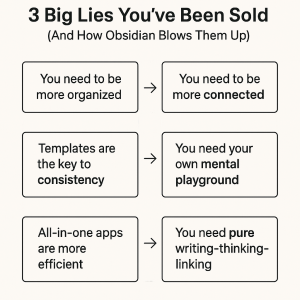
3 Big Lies You’ve Been Sold (And How Obsidian Blows Them Up)
Let’s roast some productivity myths, shall we?
Lie #1: You need to be more organized
Nope. You need to be more connected.
The smartest ideas don’t live in folders. They live in the space between notes. That flash of genius comes when you link your client onboarding process to your marketing SOPs and your latest experiment in behavioral psychology.
Obsidian’s backlinking is like having neurons firing inside your vault. Click one idea, and watch 20 others light up. That’s not organization. That’s acceleration.
Lie #2: Templates are the key to consistency
Templates are training wheels. Good to start. Useless to scale.
You don’t need someone else’s idea of a productivity system. You need your own mental playground. And guess what? Obsidian lets you build from scratch – and upgrade as you grow.
Because your brain isn’t static. So your second brain shouldn’t be either.
Lie #3: All-in-one apps are more efficient
Sure – if you like mediocre everything.
Obsidian doesn’t try to be your task manager, CRM, and coffee maker. It’s just a pure, blazing-fast writing-thinking-linking machine.
The real power? It plays well with others. Integrate with your favorite task tool, sync with your calendar, plug into GPT – or don’t.
You’re in charge.
Founders and Creators Are Building These 3 Setups in Obsidian (And They’re Insanely Effective)
Still wondering how Obsidian actually helps in real business life?
Here’s how the smartest people are using it:
- The Creator’s Vault
Build your content engine from idea to publish.- Daily note for brain dumps
- Topic maps for YouTube, blog, podcast ideas
- Swipe files linked to themes
- Evergreen content database
Result? No more scrambling for content. Your vault becomes a goldmine of ideas.
- The Founder’s Second Brain
Run your business without losing your mind.
- SOPs linked to team roles
- Meeting notes connected to KPIs
- Product roadmap that grows as you think
Result? Decisions get faster. Team gets aligned. You stop firefighting and start architecting.
- The Learning Machine
Never forget what you read, watch, or hear.
- Smart notes on books and podcasts
- Zettelkasten-style connections between insights
- Review system baked into your daily routine
Result? You don’t just collect knowledge – you compound it.
Obsidian turns your raw notes into living, breathing assets.
Start Using Obsidian Without Becoming a Markdown Monk
Let’s clear the air.
Obsidian looks intimidating.
Dark mode. Plugins. Panels everywhere.
Feels like you need a PhD in Markdown and a samurai sword to get started.
But here’s the secret: You don’t need to learn it all. You just need 10 minutes.
Here’s the founder-fast-start version:
Step 1 – Open Obsidian. Create a vault.
This is just a folder. Call it “Brain 2.0” or “The Lair” – whatever makes you feel like a genius in a hoodie.
Step 2 – Create a note.
Type stuff. Use hashtags if you want. Don’t worry about formatting. Just get your ideas down.
Step 3 – Link notes using [[double brackets]].
Write “[[Sales SOP]]” and boom – it’s a link. Click it. You just created a new note. Now you’re building connections. You’re creating a network. You’re thinking in 3D.
That’s it. You’re in.
You just went from “WTF is this” to “I’m building a second brain” in under 10 minutes.
No integrations. No Zapier. No seven-tab setup guides.
And once you’ve got that working?
Then we talk plugins.
The Plugins That Turn Obsidian From “Note-Taking App” To “Superpowered Founder Brain”
Obsidian, out of the box, is a lean beast.
But when you add plugins – oh man. It goes full Tony Stark.
Here are the top business-use plugins that actually move the needle:
- Dataview – Turn notes into dashboards
Want to see all your project notes tagged #clientX in one list? Dataview makes your notes act like a database. Think: Notion-level views without the lag and limits. - Tasks – Real to-dos, inside your thinking space
Add – [ ]and you’ve got a task. Use the plugin to see all your open tasks, sorted by due date, project, or tag. No more juggling apps. - Calendar – Time meets thought
See your daily notes laid out in a real calendar. Journal, plan, and reflect without switching context. Clean. Tight. No noise. - Canvas – Visual thinking, but for grown-ups
Lay out your notes on a grid like a moodboard. Perfect for mapping launches, product flows, or mind-warping strategy sessions. - Advanced Tables – Because formatting matters
Make your SOPs, pricing plans, or content calendars actually look pro. Clean tables. Fast.
These plugins don’t bloat. They sharpen.
Each one earns its keep. If it slows you down – ditch it.
That’s the Obsidian rule: Only add what adds value.
Why Most Zettelkasten Fanboys Miss The Point (And What Founders Should Really Focus On)
Look – Zettelkasten is cool in theory.
The original German method was about atomic notes and ideas connecting over time.
Kind of like building a Wikipedia of your own brain.
But a lot of folks get lost in the weeds.
They obsess over tagging. Note IDs. Structure. Lineage. It becomes a productivity hobby – not a tool for doing actual work.
If you’re running a business, here’s the better rule:
Use Zettelkasten like seasoning. Not the whole meal.
Break down your big ideas. Link them together. Revisit them often.
But don’t get sucked into the meta-spiral of organizing your organizer’s organizer.
Your focus is action – not academic elegance.
Obsidian gives you the power of Zettelkasten without the dogma.
Use what helps. Ignore the rest.
That’s the new way. Fast, fluid, founder-first thinking.
Want a Smarter Team? Give Them a Shared Brain
Here’s what most business owners get dead wrong about “knowledge sharing”:
They treat it like dumping documents into a Google Drive folder and hoping people read them.
That’s not sharing. That’s hoarding with permission slips.
The smartest teams today are doing something different – they’re building a shared brain in Obsidian.
Here’s how:
- Vault-as-a-Source-of-Truth
Everything the team needs to know – SOPs, project plans, brand voice, playbooks – lives in the vault. Not buried in Slack. Not locked in someone’s head. Not stuck in a Monday.com graveyard. - Atomic Notes Beat Big Docs
Forget 19-page PDFs. Break down info into small, useful notes. One process per note. One idea per page. Each note links to others. Boom – your team is navigating knowledge like a pro. - Write to Think, Not Just to Store
Encourage team members to think in public. Daily notes, meeting takeaways, personal insights – all live in the vault. You’re not just documenting. You’re building culture through thought.
With Obsidian Sync or Dropbox-backed vaults, collaboration works smoothly. And your team? They stop asking you the same question five times a week.
Some Creators Are Making Six Figures Just By Sharing Their Vaults
Yep. Read that again.
Creators are monetizing their brains – literally.
They’re building vaults filled with notes, insights, research, and templates – and then selling access. Some do it as:
- Digital products (e.g., “Creator’s Vault” for $49)
- Patreon perks (vault access as a reward tier)
- Course content (live builds + walkthroughs)
Why does it work?
Because Obsidian vaults feel raw, real, human.
It’s not polished slides. It’s how the sausage gets made.
And people love seeing behind the scenes.
You could build your own “Business Brain Vault” – SOPs, pitch templates, frameworks, investor FAQs – and sell that. Or give it away and build trust that converts later.
The vault is no longer just for you. It’s an asset.
The Future Is Local. The Future Is Linked. The Future Is Yours.
Let’s be honest.
The cloud got bloated.
The dashboards got noisy.
The apps got “smarter” – but your thinking got slower.
Now? The tide’s turning.
Founders are ditching the bloat.
Creators are rejecting complexity.
We’re all realizing: We don’t need more tech. We need fewer distractions.
Obsidian represents the rebellion.
It’s small. Fast. Fierce.
And when you build your second brain in it – you move 10x faster than your bloated competitors.
Because here’s the real flex in business today:
Clarity. Focus. Speed.
And Obsidian gives you all three.
You don’t need the hottest app.
You need your brain back.
And now, you know where to build it.